
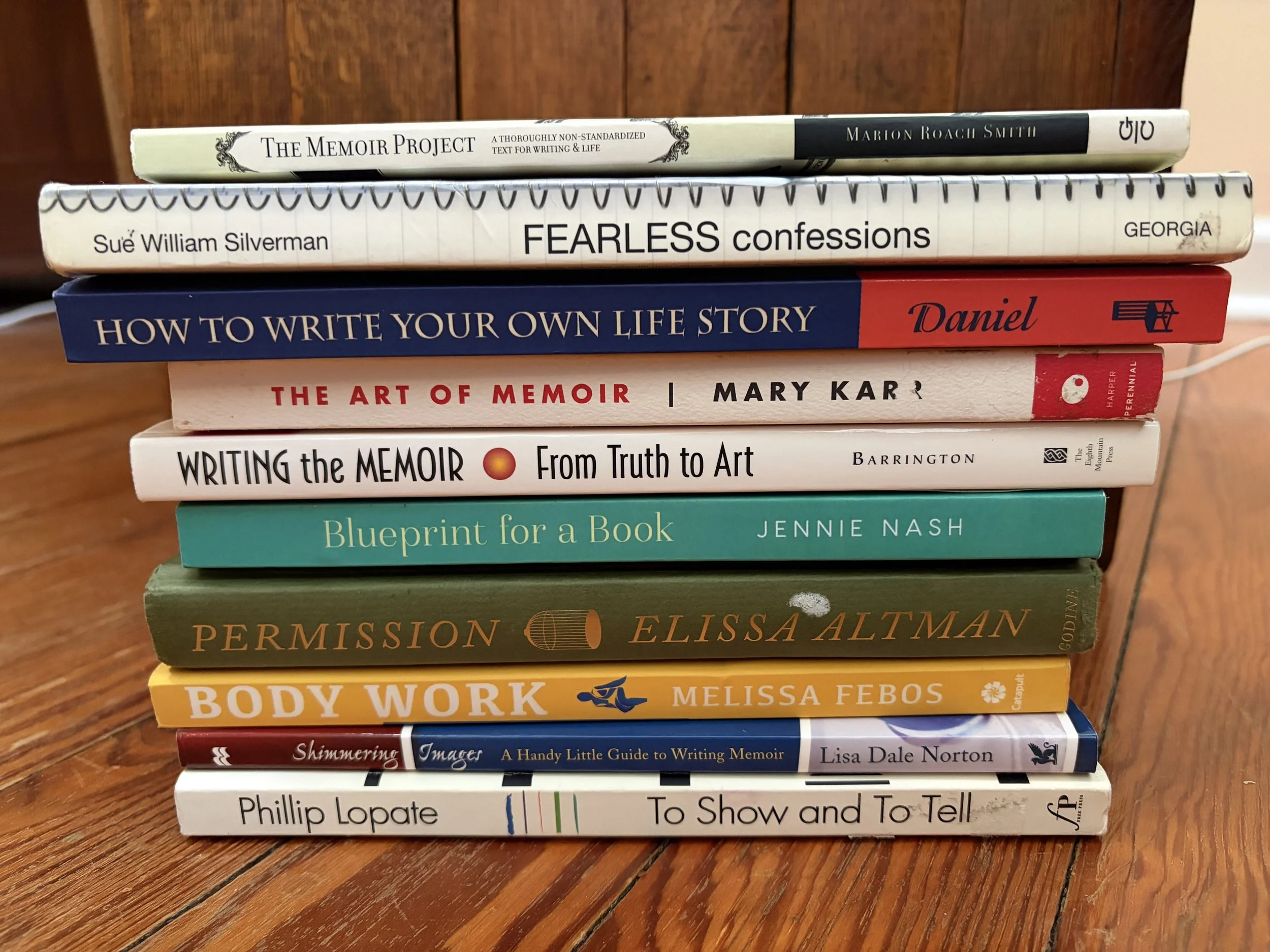
Books to Help You Write Your Memoir:
A Guide
Looking for a book to help you write your memoir? There are some great options out there, but first you need to think about what kind of help you need.
Do you want …
An overview of basic nonfiction tools like description and voice?
An analysis of the nuances of life-writing?
Prompts to help you generate ideas?
Assurances that your story is worth telling?
An explanation of honesty vs truth vs memory?
A close reading of great memoirs?
Advanced craft tips on voice and structure?
A discussion of publishing options?
A combination of the above—or something else entirely?
The guide below will help you find the best book for where you are in the writing process. For each title, I include
A basic description
Whether or not it is a how-to-write-a-memoir manual
A little about the author
For what level of writer the book is written
What is useful in the book
A few representative quotations to give you a feel for the text
Links to further reading on the book and/or author, if available
If you want more personalized advice on what to read, ask me!
Titles Covered
Listed alphabetically by author. Click on book title to go to that summary.
Elissa Altman, Permission: The New Memoirist and the Courage to Create (Godine, 2025).
Judith Barrington, Writing the Memoir: From Truth to Art, 2nd ed. (Eighth Mountain Press 2002).
Lois Daniel, How to Write Your Own Life Story: The Classic Guide for the Nonprofessional Writer, 4th ed. (Chicago Review Press, 1997).
Melissa Febos, Body Work: The Radical Power of Personal Narrative (Catapult, 2022).
Mary Karr, The Art of Memoir (Harper Perennial, 2015).
Phillip Lopate, To Show and To Tell: The Craft of Literary Nonfiction (Free Press, 2013).
Jennie Nash, Blueprint for a Memoir: How to Write a Memoir for the Marketplace (Tree Farm Books, 2023).
Lisa Dale Norton, Shimmering Images: A Handy Little Guide to Writing Memoir (New York: St. Martin’s, 2008).
Sue William Silverman, Fearless Confessions: A Writer’s Guide to Memoir (Univ. of GA Press, 2009).
Marion Roach Smith, The Memoir Project: a Thoroughly Non-Standardized Text for Writing and Life (New York: Grand Central, 2011).
Elissa Altman, Permission: The New Memoirist and the Courage to Create (Godine, 2025).
Bottom line: A meditation on how to write memoir when you feel like you aren’t allowed, whether by yourself or by others. Good for writers blocked by shame and for writers who need creative inspiration and encouragement.
Is this a how-to manual? No.
Who is the author? Award-winning Altman is the author of three memoirs, Motherland, Treyf, and Poor Man’s Feast, as well as an editor, speaker, and teacher. She has also written regular columns and essays for a number of national publications and outlets.
What level is this book? Beginning or experienced writers who want to write a memoir that deals with trauma or other charged issues.
Why read this book?
Altman’s book is a series of mostly short chapters that combine elements of memoir with arguments about permission, shame, creativity, and other issues related to writing in general and memoir-writing in particular. She centers her discussion on an analysis of why her family ostracized her after she revealed a family secret in her memoir and investigates how writers block themselves from creating out of shame and fear. She explores how to work past those obstacles and other issues like the commodification of art and comparing one’s work to the work of others. Although Altman has some specific suggestions, she mostly guides through examples from her own life and work, quotations from other writers, and declarations about art (that sometimes overreach).
This book is not for those looking for an Aristotelian argument. Its structure is spiral: lessons build on each other, but many sections overlap and she repeats points, circling back to her own story many times. However, she is at all times encouraging and passionate.
Representative Quotations:
On why we write: “We tell stories to do this very thing: to make meaning of our lives … In the writing process and through draft after draft, we actively seek clarity; we tighten the creative monocular on that which we are trying to truly see, until its edges are sharp, and its meaning becomes clear and the truth is revealed” (10-11).
On permission: “We have to recast the idea of ownership so that it becomes less binary and no longer I own this story and you don't” (13).
On getting to the truth: “Let the reader come to understand who the narrator is without being told who they are by the narrator: this is the craft of writing, and represents the good, true work that excavates the soul of the story, and separates it from that which is dogged by creative insecurity in one hand, and martyrdom on the other” (163).
More reading about this book:
Her website at elissaaltman.com
2025 Interview by Michèle Dawson Haber at Hippocampus Magazine: “Elissa Altman, Author of Permission: The New Memoirist and the Courage to Create”
2025 review by Rebecca Foster at Shelf Awareness.com: “Review: Permission: The New Memoirist and the Courage to Create”
Judith Barrington, Writing the Memoir: From Truth to Art, 2nd ed. (Eighth Mountain Press, 2002).
Bottom line: My favorite how-to manual, excellent for beginning writers and good for experienced writers who haven’t tackled memoir before.
Is this a how-to manual? Yes.
Who is the author? Writer and teacher Barrington is the author of the Lambda Book Award-winning Lifesaving: A Memoir. She has also written seven collections of poetry and a collection of shorter autobiographical essays, Virginia's Apple.
What level is this book? For beginning and experienced writers.
Why read this book?
It’s the best overall guide to writing memoir I’ve found. Her discussions of the elements of memoir are smart, comprehensive, and useful. She explains and demonstrates concepts clearly, and each chapter contains relevant writing exercises. The book covers everything from truth in memoir, craft elements like description and structure, and practical topics like legal pitfalls. Her guidance can help both beginning and experienced writers and should leave readers inspired to write.
Representative Quotations
On getting specific: “Names of cities, streets, buildings, rivers, and so on, not only carry history and image within them, they also convince a reader that the writer knows what she is talking about. As you set out to tell a story, it is vital for the reader to put himself in your hands. Naming names is one way you can win that reader's trust and give your voice authority” (123).
On endings: “If you were writing fiction, you would have the option of using the plot to provide resolution, but memoir doesn't allow you to manipulate events or characters into a satisfying closure. Your task is to provide a literary closure. In searching for this, look at the shape of the hole; picture the work in your mind: Is it balanced? Is there an important underlying question to be revisited? Are there recurring images that you can use?” (58).
On creating context: “Although inner work is essential to the writing, at some point you must take a step back and read through what you have written, asking yourself if the story is grounded in the world beyond your personal life. This grounding is important for several reasons: first of all because it allows your reader to know where he is in time and in geography” (141).
On dialogue: “In most cases [when writing dialogue], you will not have a record and will have to improvise, always keeping in mind that you are not writing fiction. By all means, leave things out; by all means, make someone’s speech clear, where it might have been so convoluted as to lose the reader; but work consistently toward the truth. For me, this again means looking hard for the heart of what actually happened, rather than for the good story that may have its seeds in experience but which takes off on a trajectory all its own” (86).
More reading about this book:
The author’s website at judithbarrington.com.
2011 review by Shirley Showalter on her website, shirleyshowalter.com: “Judith Barrington's Writing the Memoir: A Sophisticated Guide”
2008 interview with Annette Fix on WOW! Women on Writing: “20 Questions with Judith Barrington: The Truth About Writing Memoir”
Lois Daniel, How to Write Your Own Life Story: The Classic Guide for the Nonprofessional Writer, 4th ed. (Chicago Review Press, 1997).
Bottom line: An excellent book for the beginner who wants to generate ideasand/or create an informal memoir for family.
Is this a how-to manual? No, but it has some craft content
Who is the author? Daniel is a writer, editor, and long-time teacher of writing.
What level is this book? Beginners, especially older beginners.
Why read this book?
This book came out of a course Daniel developed for beginning writers who wanted to write their life story for family and friends. To that end, it has basic suggestions for how to go about writing and short chapters on research and revision, but it is sparse on craft and information on publishing. Also, due to the book’s age, some guidance is outdated, especially in terms of the use of technology.
The strength of the guide is its suggestions for topics to write about. Daniel envisions students writing not necessarily a unified narrative but instead a series of memories, so she provides a long list of areas to consider. For each topic she gives ample examples from her students and herself. The topics range from “Holidays” and “Family Traditions” to “Accomplishments of Which You Are Most Proud” and “Immigrants.” She also has additional ideas listed at the end of the book. The topics are specific enough to spark ideas and broad enough to allow writers to go in many directions.
Note: Daniel can be well-intended but tone-deaf on issues about race, and her writing examples come from a limited subset of human experiences.
Representative Quotations:
On memory and perspective: “It would add interest to your book if you could persuade your spouse—or sister, brother, or any other family member, or friend—to write a chapter about something you both experienced … If someone disagrees with you about something you're writing, invite them to write their own chapter on the same subject and include it in the book. Even if there's no dispute, though, no two people have exactly the same experience in a given situation” (93).
On writing about others: “Writing about your parents may bring back sweet memories or bitter memories, or a mixture of the two, depending on your relationship to them. Whatever your memories, strive for complete honesty … Your adult perspective will enhance your story. Remember, their parents and grandparents were individuals as well as parents and grandparents. Tried to present them as individuals” (39).
On the topic of “Children and the Things They Say”: Anyone who has ever been around children for any length of time knows countless stories about bright, cute, funny, or touching things children say. Recalling these stories can have a double purpose. First, of course, if you write them down you are saving them for the children to read when they grow up and you are also saving them for future generations.
A second reason for preserving these stories is that telling them is a wonderful way to get the children and young people in your family interested in family history” (115).
Melissa Febos, Body Work: The Radical Power of Personal Narrative (Catapult, 2022).
Bottom line: An insightful collection of essays that analyzes and explores how memoir changes those who write it.
Is this a how-to manual? No, though it contains some advice.
Who is the author? Writer and teacher Febos is the author of the memoirs/lifewriting essay collections Whip Smart, Abandon Me, Girlhood, and Dry Season.
What level is this book? For experienced writers, especially those who have not written memoir before.
Why read this book? To get a higher-level understanding of why we write memoir, what to try to do in your memoir, and what you can get out of writing memoir. I highly recommend it for writers who want to think more about the theory of lifewriting and want some advice with solid analysis and experience behind it. Febos is well-read, and these essays are as enjoyable to read as they are thought-provoking.
The first essay argues for the value of writing about one’s self, especially about trauma. The second is about the necessity of writing with self-awareness. The third, “A Big Shitty Party: Six Parables of Writing about Other People,” contains valuable advice based on her experiences. The final essay, my favorite, considers the ways that writing about your life leads to understanding your life better which in turn leads to better writing about your life.
Representative Quotations:
On the importance of a self-aware narrator: “There are many beautiful and acclaimed books that I have begun and found astute in any number of ways. However, if such a book strikes me as asleep to its own biases, if it lacks that glint of authorial awareness and the characters’ self-delusions, my attention drifts” (43-4).
On not censoring yourself when you draft: “We write to understand things. If we already understood them, most of us would grow too bored to complete the immense task of writing a book about them. So, if you begin by leaving things out, skirting around them or obscuring them, you may be leaving out vital organs that your book cannot live without. Put it all in.” (87-8).
On perspective: “Successful narration of a memoir depends upon the careful interplay of the past I and the present—whether it be explicit or implicit in the text. Self-knowledge, the insights available in the past and acquired in the time since, are what gives memoir its depth. It is not experience that qualifies a person to write a memoir, but insight into experience, and the ability to tell a story of the past that contains both dimensions. That is, the past experience has been integrated into the larger narrative of the author’s life. For me, and I believe for most memoirists, the process of writing is also a process of comprehension, an examination of the past that yields new understanding” (137).
More reading about this book:
2022 book review by Sam Paul on The Feminist Book Club: “Book Review: Body Work by Melissa Febos”
2022 article/review by Jean Guerrero in the LA Times: “More navel-gazing, please. Melissa Febos thinks personal essays can change the world.”
Febos’s official website at melissafebos.com
Mary Karr, The Art of Memoir (Harper Perennial, 2015).
Bottom line: A wonderful discussion of what makes a good memoir and some good craft advice.
Is this a how-to manual? Partly. (See below.)
Who is the author? The award-winning and best-selling writer and teacher Karr is the author of three memoirs, The Liars Club, Cherry, and Lit, as well as five books of poetry.
What level is this book? Mostly for experienced writers, but beginning writers can also benefit.
Why read this book?
Reading anything by Karr is a valuable and pleasurable experience. In this book she is as always wise, generous, funny, and blunt. She gives lots of examples from her own writing experiences and explains many concepts effectively. She uses a range of memoirs to demonstrate her points, does a lot of close analysis of good writing, and has an excellent reading list in the appendix. The book deserves all the praise it has received
However, keep in mind that The Art of Memoir is not a how-to manual. It most resembles a series of lectures in a college class on writing memoir, and Karr often refers to courses she has taught. There are discussions of all the major issues from truth to description to structure, close readings of texts, and some specific dos and don’ts, but Karr does not include detailed craft lessons, writing exercises, or step-by-step instructions. Also, the book is organized more by feel than by a pedagogic framework, and sometimes her guidance may leave you feeling stranded—for example, chapter seven, “How to Choose a Detail” doesn’t do so explicitly, and on voice she says, “The only way I know to develop a voice is to write your way into one (52).”
Representative Quotations:
On honesty: “For veracity’s sake, it doesn’t cost a memoirist the reader’s confidence either to skip over the half-remembered scene, or to replicate her own psychic uncertainty—‘This part is blurry.’ Any decent comp teacher schools you to work in the realms of maybe and perhaps. The great memoirist enacts recall’s fuzzy form. That’s why we trust her” (15).
On voice: “Each great memoir lives or dies based 100 percent on voice. It's the delivery system for the author’s experience—the big bandwidth cable that carries in lustrous clarity every pixel of someone's inner and outer experiences. Each voice is cleverly fashioned to highlight a writer’s individual talent or way of viewing the world” (35).
On structure: “Young writers often ask me to help them order information in a story. But there's a proven method you can try. Imagine sitting down to tell it to a pal at lunch. You'd have no problem figuring out what goes where” (147-8).
On process: “You think you know the story so well. It's a mansion inside your head, each room just waiting to be described, but pretty much every memoirist I've ever talked to finds the walls of such rooms changing shape around her. There are shattering earthquakes, tectonic-plate-type shifts. Or it's like memory is a snow globe that invariably gets shaken so as to shroud the events inside” (152).
More reading about this book:
2015 review by Janet Maslin in the New York Times: “Review: ‘The Art of Memoir,’ by Mary Karr, Is a Veteran’s Guide”
Mary Karr’s 2015 response to the Maslin review in the LA Times: “How Writers Dig Up the Past”
2009 interview by Amanda Fortini in the Paris Review: “Mary Karr, The Art of Memoir No. 1”
Phillip Lopate, To Show and To Tell: The Craft of Literary Nonfiction (Free Press, 2013).
Bottom line: A fantastic collection of essays and talks that covers major issues in memoir, analysis of good memoirs, and Lopate’s beliefs and theories from a long career of writing and teaching.
Is this a how-to manual? No, but it contains some craft tips
Who is the author? Lopate is a renowned writer of nonfiction, fiction, and poetry. His memoirs and personal essay collections include Portrait of My Body, A Mother’s Tale, A Year and a Day: An Experiment in Essays, and Waterfront: A Walk Around Manhattan. He has also edited numerous anthologies including the classic The Art of the Personal Essay and has taught every level of student from children to graduate students.
What level is this book? For experienced writers.
Why read this book?
Lopate writes elegantly and precisely about complex issues. He is particularly compelling when discussing the narrative self, the self as character, the differences between fiction and literary nonfiction, and the process of creating voice on the page. He is worth listening to not only for the work he has produced but also for his dedication to his genre and his ability to practice what he preaches in these pages. Not every section is specifically relevant to memoir, but almost all his ideas can be applied to memoir. The included reading list is comprehensive as well. Lopate’s love of writing and of teaching writing comes through on every page.
Representative Quotations:
From “The State of Nonfiction Today”: “But as soon as I assert that I am writing ‘the truth,’ my palms sweat and I think I am about to perjure myself … We may not ever be in possession of the truth, but at least as nonfiction writers we can try to be as honest as our courage permits. Honest to the world of facts outside ourselves, honest in reporting what we actually felt and did, and finally, honest about our own confusion and doubts … The challenge faced by the nonfiction writer is to take something that actually happened, to herself or to others, and try to render it as honestly and compellingly as possible” (13).
From “Reflection and Retrospection: A Pedagogic Mystery Story”: “In writing memoir, the trick, it seems to me, is to establish a double perspective that will allow the reader to participate vicariously in the experience as it was lived (the child's confusions and misapprehensions, say), while benefiting from the sophisticated wisdom of the author’s adult self. This second perspective, which takes advantage of a more mature intelligence to interpret the past, is not merely an obligation but a privilege and an opportunity” (26).
From “On the Ethics of Writing about Others”: “Granted, writing about one's family or intimates can be an aggressive, vindictive act, but it can also be a way of communicating something to loved ones you never could before—a ‘gift’ of the truth of your feelings. It can poison the air or clear it” (84).
From “Modesty and Assertion”: “To be a writer is a monstrously arrogant act” (86).
More reading about this book:
2013 review by Elinor Langer in The Oregonian: “'To Show and To Tell' review: Phillip Lopate gets personal with essays
2013 interview by Jeffery Gleaves in Harper’s Magazine: “Portrait Inside My Head and To Show and To Tell: Phillip Lopate on eclectic curiosities and the old-school essayists
2013 review by Morris Dickstein in The New York Times: “The Daily Round”
Jennie Nash, Blueprint for a Memoir: How to Write a Memoir for the Marketplace (Tree Farm Books, 2023).
Bottom line: A clear guide for creating a detailed plan for writing a marketable book, as well as guidance on developing a proposal and a pitch for agents and publishers.
Is this a how-to manual? Partly (see below).
Who is the author? Nash is the founder and CEO of the book coaching company Author Accelerator. She is an editor and writer and has published three memoirs as well as several novels.
What level is this book? All levels.
Why read this book?
With explanations, examples, and exercises, Nash takes prospective writers through a step-by-step, detailed process for figuring out what your memoir is about, who your memoir is for, and how your memoir should be structured. She then guides readers through the process of creating a book proposal and pitch and finishes with an excellent list of resources. All of her guidance is with the aim of creating a memoir that can be marketed.
The strengths of the book are her clear organization, her use of case studies to illustrate her concepts, and her many specific tips and instructions. Most readers will benefit from her experience and wisdom. However, note that she does not cover the actual drafting and revising of a book or include support on craft issues besides structure and theme.
Representative Quotations:
On creating a short summary of your book: “Make sure the super simple version is short—just two or three sentences. The constraint to keep it short has a purpose: it forces you to focus and to choose. If you find yourself writing too much here, stop and force yourself to keep it simple.” (26).
On how to structure your memoir: “The concept for memoir is not just performative; it's not just a structure you impose on the material to be clever. It's a way to make your point. It's a way to showcase the transformation journey that you want to take the reader on. It's a way to frame the material and invite the reader into your experience. It's integral to the story. Usually, when I swoon over a memoir, I'm swooning over the concept, or the way an author decided to organize and present their material. It elevates the story because it is outward proof that the author did the work …” (90).
On when to stop planning and start writing: “How do you know when you're finished with the Blueprint?
It's not just when you work through the 14 steps and can tick them off as done. The goal is to be able to see your story — both how you will write it and how your reader will receive it — and to love it so much that you are ready to write forward with confidence. This almost always means that you need to go through the steps multiple times, continuing to ask yourself the core questions again and again …” (149).
More reading about this book:
Her website at jennienash.com
2023 interview with KJ on Jennie Nash’s #amwriting podcast on SubStack: “Memoirs for the Marketplace: A Blueprint for Success”
Lisa Dale Norton, Shimmering Images: A Handy Little Guide to Writing Memoir (St. Martin’s, 2008).
Bottom line: Guides writers through a straightforward and effective process of writing an audience-focused memoir that includes both specific moments and overall meaning.
Is this a how-to manual? Yes
Who is the author? Dale wrote the hybrid memoir Hawk Flies Above: Journey to the Heart of the Sandhills. She is also a long-time editor and teacher of memoir and narrative nonfiction.
What level is this book? Beginners or intermediate writers new to memoir.
Why read this book?
Norton walks readers through a memoir-writing technique she has developed over countless hours of teaching. The first section discusses why we should write memoir, addresses basic issues like truth vs facts vs honesty, and explains why it is essential to use a compassionate viewpoint. Part two explains each step in her process, including creating a timeline of turning points in your life, identifying key moments from your memories, choosing what part of your life you want to focus, determining a structure, and finding the bigger meaning. The last section covers some basic craft tools including point of view, voice, and figurative language (which she calls “imagery”).
Norton believes the most important reason to write memoir is to learn about yourself and share that knowledge with others. Her tone is both direct and passionate. To follow her method requires going all in on trusting her: she is often very specific and sometimes proscriptive, but she also believes that writers will figure out certain things on their own.
Representative Quotations:
On considering different topics: “Writing about your life is hard work. It requires you to be emotionally truthful, and truthful tales of the inner life are hard to get out, a little like digging embedded slivers from the soft part of your hand” (39).
On revealing meaning in your story: “Memoir is not about having tidy answers to everything. It's about making a truth of your experience, and sometimes the truth is that you don't get it” (81).
On where to start your story: “Every story about your life, every slice-of-life memoir, needs to begin somewhere. To be a story that people want to read it has to serve up to the reader the possibility of a ‘problem’ that will be ‘solved’ during the course of the story.
Now, I don't mean necessarily a blatant problem, like the dead body that brings up in the first paragraph of many mysteries, but rather the possibility of the reader following a narrator as he unravels the impact and comes to term with some life complexity period in other words, a rousing tale of you getting to be the hero of your own life” (31).
More reading about this book:
Norton’s website at lisadalenorton.com
2013 repost of a 2008 interview with Theo Pauline Nestor on the website for the Wild Mountain Memoir Retreat: “An Interview with Lisa Dale Norton, Author of Shimmering Images”
Sue William Silverman, Fearless Confessions: A Writer’s Guide to Memoir (Univ. of GA Press, 2009).
Bottom line: A good comprehensive manual on writing memoir, especially those writing about trauma.
Is this a how-to manual? Yes
Who is the author? Silverman is a teacher and editor as well as the author of five memoirs/autobiographical essay collections, including the award-winning Because I Remember Terror, Father, I Remember You. She has also published three poetry collections and another writing manual, Acetylene Torch Songs: Writing True Stories to Ignite the Soul.
What level is this book? Beginning writers and experienced writers who haven’t written much nonfiction or memoir.
Why read this book? It uses an effective organization and provides excellent explanations of writing tools and issues specifically related to memoir. She covers standard craft topics like plot, theme, imagery, and style and provides useful writing exercises for each. Her chapter on point of view and voice is especially good. Her chapter on publishing is outdated in many respects but still has helpful points, and there is also an interesting section on the different types of nonfiction.
Because Silverman considers herself a “confessional” writer and has written a lot about trauma, this book is particularly relevant for writers tackling such subjects. In particular, she has a chapter on confessional writing that discusses the therapeutic benefits of writing about trauma, the value of revealing secrets, how to write about difficult topics and share this work with others, the question of truth in memory, and an analysis of popular criticism of confessional writing. The biggest weakness in the book is her choice of texts to illustrate her points, but she includes an excellent reading list in the appendix.
Representative Quotations:
On voice and point of view: “To better understand and differentiate how voice is used in memoir, I've developed two main categories by reimagining phrases originated by the poet William Blake: The Song (or Voice) of Innocence and the Song (or Voice) of Experience.
You can think of the Voice of Innocence much like the horizontal plot line: it's the voice that tells the story of what happened, the events. On the other hand, think of the Voice of Experience like the vertical plot line: it'sthevoice that interprets or reflects upon the events” (51).
On memory and truth: “Readers know we don't run a video camera 24/7 or record conversations. Intelligent readers know I'm conveying how events felt and seemed to me, what they mean to me now. Memoir is not journalism. It's not supposed to be. When I write memoir, my goal isn’t transcription or reportage. Nor do I make stuff up. My interpretation of events forms a reality that is uniquely mine—my truth — how I understand my own life” (126).
On imagery: “The ‘right’ words we seek are those that artistically re-create our worlds, internal and external, on the page, by evoking how those worlds feel, taste, sound, smell, look. In real life we might think to ourselves, I feel lonely. Or, I think I'm in love. In memoir, however, we translate our abstract feelings (“love,” “loneliness”) into concrete language … Images aren't merely flat scenery or wallpaper. An image directs the reader to an insight, brings your work to a higher emotional pitch, embodies your persona’s feelings and ideas — the emotional and physical habitat in which you dwell” (16).
More reading about this book:
2010 review by Debbie Hagan at Brevity magazine: “Review of Sue William Silverman’s Fearless Confessions: A Writer’s Guide to Memoir”
2009 guest blog post and writing exercises by Sue Silverman at the Women’s Memoirs website: “Who Is that Masked Memoirist?”
Her website at suewilliamsilverman.com
Marion Roach Smith, The Memoir Project: a Thoroughly Non-Standardized Text for Writing and Life (Grand Central, 2011).
Bottom line: A practical and idiosyncratic writing guide for beginners or experienced writers new to memoir.
Is this a how-to manual? Yes.
Who is the author? Smith is a writer, teacher, editor, and book coach who focuses on memoir. She has written two books and had a long career writing for numerous national outlets. She runs a website at marionroach.com called The Memoir Project, which includes classes and online resources.
What level is this book? Beginners and intermediate writers new to memoir
Why read this book?
Smith has a solid method for teaching memoir honed over many years. Her book focuses on writing short pieces, but the methods can be expanded into longer pieces, including a full-length memoir. She encourages writers to think of their memoir as an argument and to start with a statement that defines the big idea or abstract topic they will write about and the life events they will use to illustrate that idea/topic. She also covers many basic tools like description, editing, and revision. Best of all, she is an encouraging realist: she makes it clear that writing is hard but do-able.
However, the book’s organization is weak, and the chapter and section titles can make it hard to find what you’re looking for. Some material, such as the research section, is outdated.
Representative Quotations:
On why you should write a memoir: “Everyone has a story. Also, whether you are a beginner or someone who has written for years, your challenges are nearly the same, since memoir writing is a great equalizer, smoothing the playing field to a large degree, while pocking it with the very same hazards for all” (7).
On what to include: “How it happened is not what makes it interesting. That it happened at all—why it happened and where you go from there—is interesting” (25).
On using getting through your first draft: “I would argue that in no other form of writing is the use of saccharine, vomity, clichéd place markers more appreciated than in memoir, since they are the fastest route to demystifying your own experiences, allowing you to see those experiences for what they are. Attach a couple of tired old phrases to your first bad boyfriend and presto-chango, he becomes an archetype, or better yet, a stereotype, and you'll be freed up to write his badness down to the last chewed toothpick” (77).
More reading about this book:
Marion Roach Smith’s website at marionroach.com.
Review by Heather Richard at Story Catching Studios on Substack: “Books for Writers #1 - The Memoir Project: The argument for writing an argument”
2011 interview with Neal Conan on NPR: “'Memoir Project' Gives Tips For Telling Your Story”